
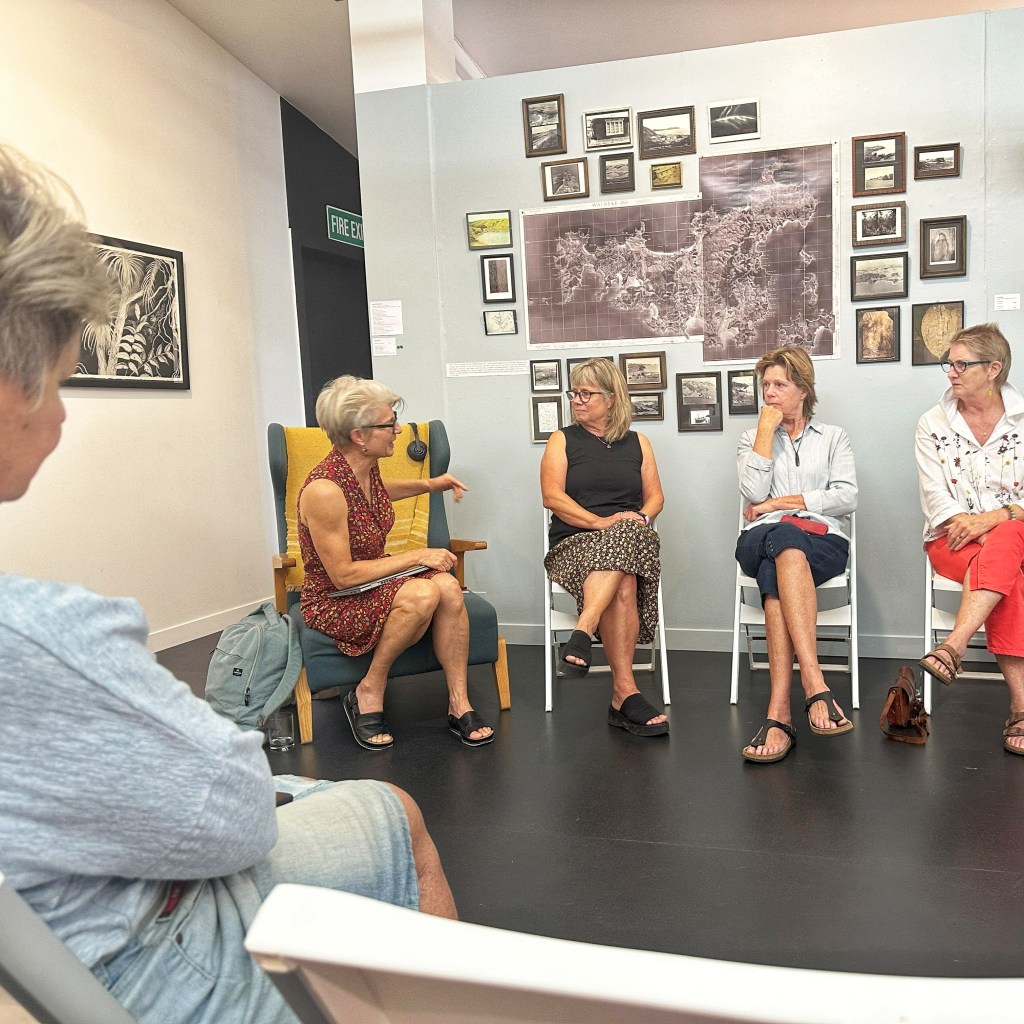
The Understory exhibition at the Waiheke Community Art Gallery (March 21 – May 4) brought together 25 artists – some established, others emerging – to celebrate conservation on Waiheke. Why? Because community leadership has driven the transformation from barren paddocks to ever-expanding areas of nascent forest and thickening understory. In keeping with the community focus of the exhibition, a public engagement program was designed to broaden the scope of exhibition visitors and to encourage creative play in the Understory Restoration Zone.
The panel featured three artists (with works in the exhibition): sculptor Kiya Nancarrow, photographer Peter Rees, painter Katie Trinkle-Legge, along with two local conservation champions Rosemary Thorne (Te Matuku stoat trapping) and Norm Robbins (Friends of McKenzie Reserve and Te Korowai o Waiheke). The panel was brought together and facilitated by me, Monica Peters, Understory coordinator.
Experiencing “hope” on Waiheke
To kickstart the discussion, I asked panellists where they went on the island to experience “hope”. The closest to home was Kiya, who spoke about the power of place at the bottom of her garden, where she uncovers buried wood for her sculptures. Peter described a series of tracks strung together in a circuit in Whakanewa Regional Park that he visits frequently, and how certain evening light creates magic in the forest. For Norm, the remnant primal forest on Ngati Paoa land he visits while working provides the “why” for his conservation mahi.
The Stories Trees Tell: History, art, and ecology
KT: I can’t imagine…the noise and the destruction… it was all progress …part of how you tamed the land. So, [kauri] just kept popping up, as my iconic New Zealand tree… this magnificent victim
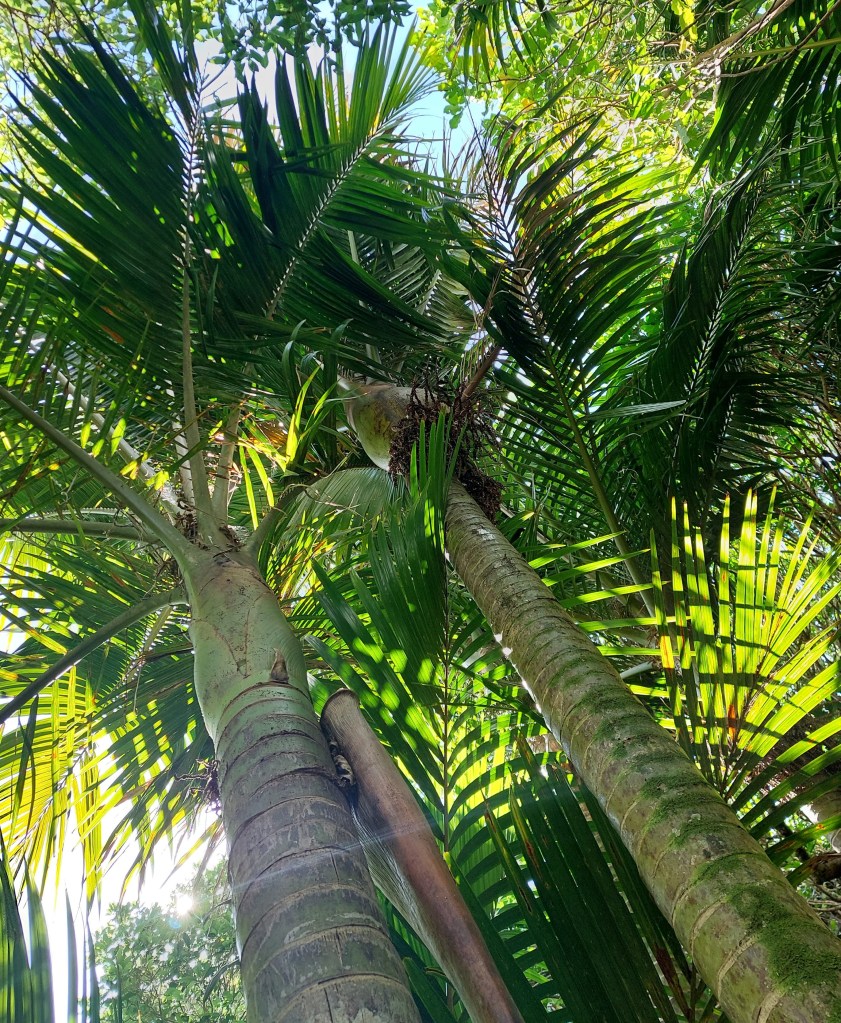
Katie became fascinated by kauri when learning that the deep grooves on her property were the legacy of sliding massive logs downhill for milling. However, unable to find a “majestic” enough specimen on Waiheke to paint on kauri floorboards she had collected for the exhibition, inspiration was found on the mainland. Large old kauri – survivors of the rampant logging in the 1800s, can still be found on Waiheke, though only in small pockets, and mostly tucked away on private land. Kiya’s exhibition pieces are exhumed boughs of pūriri – a species that can live for two millennia. She has heavily brushed and worked the wood to reveal the gnarled grain. Both artists focus on the tree itself: stature, structure, age, ecology and elegance, a blend of science and aesthetics. Their works also comment on how these trees were once seen as mere resources to be extracted.
Regeneration in Action: From Barren hills to living forest
Waiheke is a challenging landscape – hills, cliffs, gullies, poor soils and weeds. So many weeds! But change can occur quickly – Kiya described how her neighbour used to ride directly to the beach through open terrain “…and now it’s just something spectacular, big trees”. In most areas, the original forests were cleared long ago – century-old images of the 4-hectare McKenzie Reserve show broad swathes of pasture, later planted in pines. In 2002, an ambitious plan was hatched to replace the now huge exotics with native forest. Norm described the native tree canopy in the reserve now reaching 6-7m. More recent developments include the construction of wide platforms, which invite visitors to pause, sketch, stretch or simply soak in the forest atmosphere.
Embracing Experimentation: Learning from hands-on Conservation in action
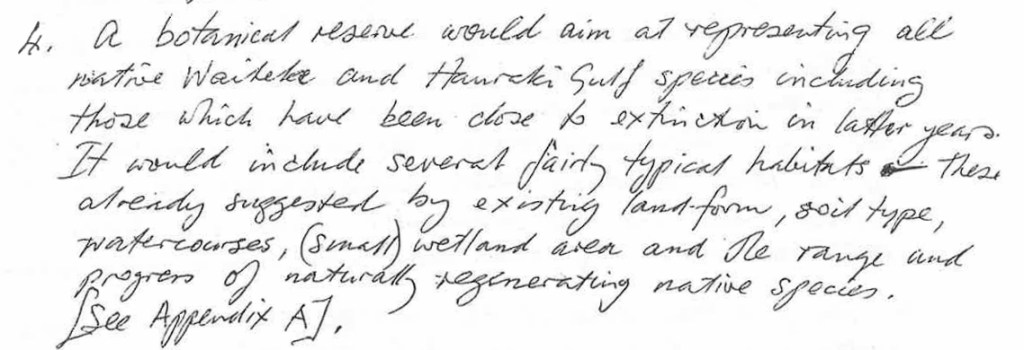
Learning by doing has been a powerful way of measuring and assessing the effectiveness of conservation approaches. For Rosemary, it’s recognising the value of weeds like gorse – the bane of farmers but an important nitrogen fixer, as a nursery crop for native species. As the latter grow, light-loving gorse is shaded out – but this takes time. She advises against trying to manicure nature, instead opting for natural regeneration where possible. In McKenzie Reserve, Norm has trialled novel approaches for managing persistent weedy vines on steep clay banks and has observed how the same native species grows so differently around the reserve. It’s all tremendously hard work and very long-term. This is of huge interest to me, having investigated the motivation for conservation volunteerism intensively for many years (see here and here) and through my PhD.
Birdsong and the Return of Wildlife
On Waiheke, a powerful outcome of removing predators (stoats and rats) and strengthening habitat by planting and weeding is the return of birdsong. Peter likened Ōmiha to Jurassic Park, kākā in ever greater numbers filling the air with their strident skrarks, screeches and repeated, rhythmic ka-aas. With weka migrating across the island, and tūī and kererū ever present, birds provide Peter with easy inspiration for his photographs. But he also highlighted that we still have some way to go to reach the glorious cacophony first recorded by Cook on his arrival to Aotearoa in the 1700s.
RT: We’re very proud of the work we’ve done… we’ve learned the hard way, [with] a few tears [along the way] …my big vision was the dawn chorus …to hear the birds, and we certainly are hearing the birds
Restoration Lessons: Art, education, and the power of place
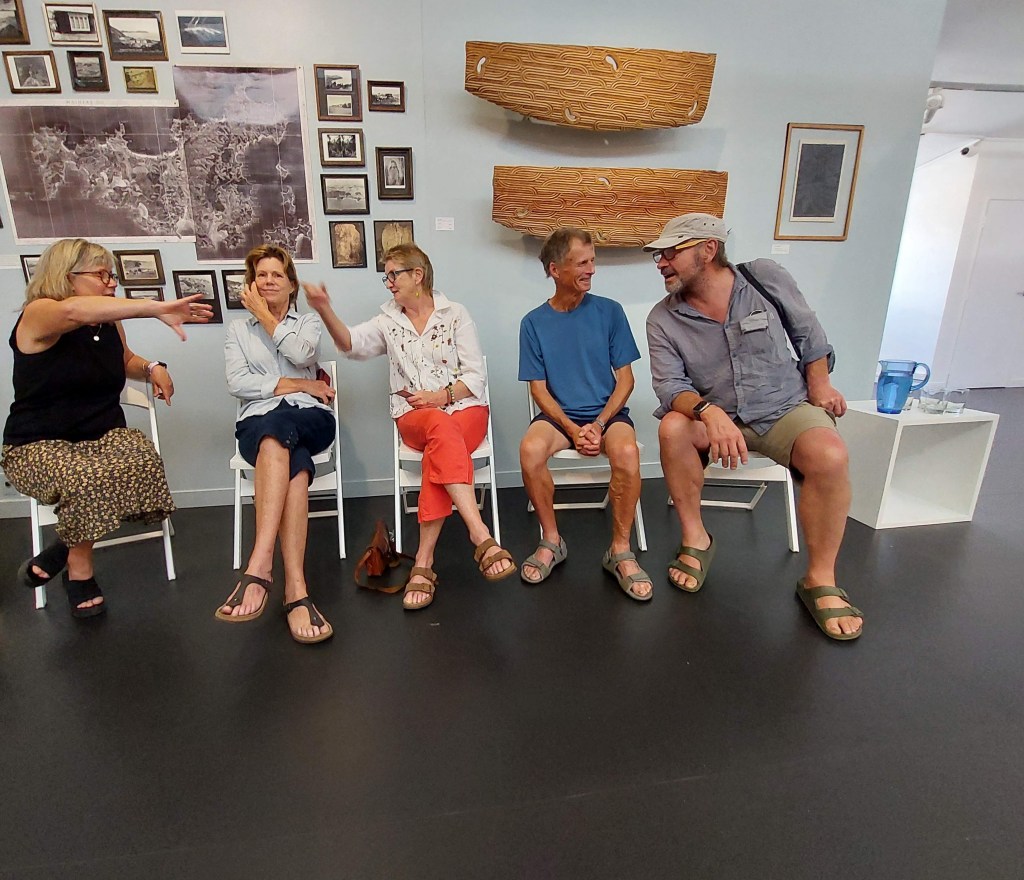
Panellists shared how the arts can play a vital role in Waiheke’s ecological revival, inspiring people to look at nature more closely – to notice the complexity in a leaf or the play of light through trees. Education was also highlighted: when people connect emotionally with the land, they become its advocates. For Katie this means inspiring young people… “…often when I teach, I bring in natural objects, it’s a great starting point for young people to actually look… [and pay] attention to things in the world…”
Waiheke’s ongoing transformation is not just ecological. The panellists each revealed that conservation has many dimensions – cultural, social, and deeply personal. The arts have a strong role to play, being both a bridge and a window into nature, just as hands-on work is continually needed to manage weeds, remove predators and plant native species.
 monicalogues
Thanks Monica, You’ve woven this together beautifully! Nga mihi, Sid
LikeLike