

Arrivals… and departures. Image: Bernd Thaller
Arrivals and departures… this is the final blog of a series that summarises key themes from discussions with citizen science coordinators, visionaries, researchers, educators, movers and shakers across 4 different countries in 5 weeks. Having time to sit down and explore a wide range of themes face to face was extremely valuable. These discussions shed light on the complex relationships between citizen science stakeholders, their institutions, partners, funders, outputs (e.g., databases) and projects. They also elucidated organisational internal structures (e.g., working groups and their topic areas within the Citizen Science Associations, Centres and Networks). The information gathered will help shape citizen science in NZ by placing us (with our fledgling Citizen Science Assn. of Aotearoa NZ) firmly in the global picture.
In Singapore and some European countries, citizen science is (mostly) supported by a strong infrastructure
- Support for, and integration of citizen science across different countries is variable. For example, England has a strong history of biological recording which has set the scene for a vibrant citizen science movement.
- Networks in Asia are evolving with as CitSciAsia gathers momentum.
- The interrelationships between networks, associations, platforms/databases are complex and multi-layered. Each citizen science entity (e.g., association, network, platform, project) operates at different scales (regional, national and international), but all generally seek to foster communication and collaboration with public participation, educational and scientific research goals.
- Universities, learning and research institutes (such as museums) provide strong foundations for citizen science initiatives by providing infrastructure for projects (e.g., admin, staff time) and organisations such as the European Citizen Science Assn. (ECSA).
- External support from recognised institutions such as universities and Natural History Museums enhances the credibility of citizen science associations and networks. The Austrian Citizen Science Network found a basic Memorandum of Understanding helped build credibility of the organisation along with formal recognition from their host institution (University of Natural Resources and Life Sciences – BOKU).
- Partnerships and funding from education and/or science-based government ministries has enabled the development of the Austrian Zentrum für Citizen Science and Bürger schaffen Wissen in Germany. The Citizen Science Centre in Zürich, Switzerland is supported by the Swiss Federal Institute of Technology Zürich and the University of Zürich
- Internships and student-helpers support initiatives such as ECSA deliver outputs by contributing time to flagship projects (e.g., D-Noses).
- ECSA Working Groups highlight the breadth of citizen science activities underway in Europe and beyond: Sharing Best Practice and Building Capacity; Projects, Data, Tools, and Technology; Policy, Strategy, Governance and Partnerships; Learning and Education in Citizen Science; Citizen Science and Open Science; Empowerment, Inclusiveness, Equity. Narrower (project) topic areas include BioBlitzes; Global Mosquito Alert and Air Quality.
- Institutes forming part of the Viennese Ludwig Boltzmann Gesellschaft actively foster new participatory approaches to science with and for the wider public. The focus of their work extends into many newer fields for citizen science including medicine, social, cultural and life sciences.
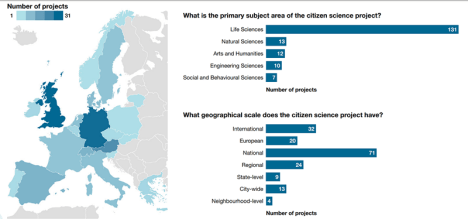
Map of citizen science activities across Europe (2016), project topic/field and geographical. Source: European Commission Open Science Monitor 27
European citizen science projects can be large-scale and complex
- Large pan-European funding (e.g., Horizon 2020) provides opportunities for projects at huge scale – DITOS and the 500 events carried out over the 3y duration of the project is just one example; D-Noses which investigates odour pollution is another.
- The ability to move quickly and easily between European countries means peer-to-peer networking is frequent and easy and is supplemented by online meetings. The COST (European Cooperation in Science and Technology) action programme provides 4 years of funding from the EU to support networking activities, such as working groups, conferences, workshops, short travel expenses and joint publications. Although no funding for research is included, an output of the ‘Citizen Science to promote creativity, scientific literacy, and innovation throughout Europe’ COST action will be a book that brings together participants’ experiences given the diversity of countries involved and the different ways in which citizen science is understood and developed.
- Multiple partners from many different countries in the EU add layers of complexity to projects – given the necessarily collaborative nature of projects. This means that resources, surveys, feedback etc. all need to be translated into local languages and then back into English.
- The 299 Austrian Sparkling Science projects carried out have partners spread throughout Europe, as well as Africa, Asia and the US.
iNaturalist promotional image for the annual ‘City Nature Challenge’
The cultural and historic connection to nature has implications for environmental project design
The relationship to the natural world and biodiversity differs markedly among cultures. In Singapore, for example, there is a very limited amount of wilderness that can be accessed and consequently very limited cultural harvest of natural products. This has implications for environmental citizen science project development and participant engagement. However, this can also be a drawcard – sampling in muddy coastal environments has proved to so novel for urban Singaporeans that participation has been limited to protect the sampling sites. In England by comparison there is a long history of bio-recording and a network of centres with databases for biological data.
There are multiple learning opportunities for citizen science history, philosophy and practice
The University College of London offers a free online introductory course in ‘Citizen Science and Scientific Crowdsourcing’. However, there are an increasing number of short-term training opportunities in Europe. Recent events include:
- The Earthwatch-led ‘NERC Community for Engaging Environments’ The 5-day event will eventually be delivered in day-long modules, enabling participants to learn content at more strategic stages of their research journey
- Over the 2019 summer, another week-long training event ‘Citizen Science – Innovation in Open Science, Society and Policy’ took place in Germany, delivered by the German Centre for Integrative Biodiversity Research (iDiv) Halle-Jena-Leipzig in cooperation with the Helmholtz Centre for Environmental Research (UFZ)
- A 5-day programme on ‘Citizen science in theory and practice’ was hosted by the Vienna Doctoral School Cognition, Behaviour and Neuroscience (University of Vienna), delivered by a range of coordinators, researchers and leaders from different countries.
- The Citizen Science Awards administered by the Austrian Centre for Citizen Science is a novel way to reward participation in citizen science projects.
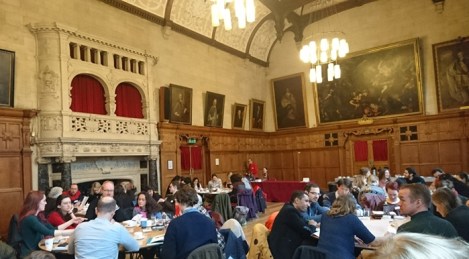
Citizen Science Training Day, ExCiteS programme at University College London. Photo: Alice Sheppard
Evaluating projects and funding programmes
Building an ‘evaluative culture’ is the first step toward developing processes for evaluation to take place as part of a project journey. For example, evaluations to track progress at 3 stages throughout Austrian Sparkling Science projects (i.e., beginning, middle and one month after completion) were standard practice. Research ‘impact’ is now another dimension that surpasses basic delivery of outcomes and will increasingly be brought into citizen science initiatives to determine their overall value.
Projects are becoming increasingly diverse as a shift occurs in the approach to research and public engagement
- Within Europe a strong gradient exists with citizen engagement (e.g., in science and environmental decision-making) across countries owing to cultural and historical factors. This invariably creates challenges for multi-national projects. Opportunities for knowledge-sharing (e.g., workshops) are typically built into large-scale projects to build capacity and understanding between participants from different countries.
- The range of socio-cultural citizen science projects is growing in Europe as well as experimental projects that connect art and creativity to scientific practice.
Citizen science scope and boundaries are still contested
Active debate continues around what constitutes citizen science and is likely to remain contested as the field continues to grow. The goal of the Working Group on Citizen Science Networks is to frame transparent criteria that will help determine whether projects should be listed on citizen science platform/databases. Th purpose is to facilitate the exchange of projects between networks and enhance project comparability.
Citizen science outputs are broad, and may have long term implications
- University support ensures that peer-reviewed publications are produced and publicized, often on open access platforms. This ensures that data are not lost or hidden in reports with limited circulation.
- Connection to and buy-in from industry means projects such as D-noses have scope to create change on the ground extending beyond awareness-raising of issues and data collection.
- There is a much stronger interface with policy overall – both at an organisational level (i.e. ECSA) and at a project level (e.g., DITOS and D-Noses) where policy development is an important goal.
- Citizen science is making important contributions to global initiatives (e.g., Mosquito Watch; citizen observatories) with much potential to contribute to the UN Sustainable Development Goals.
Wrapping up the wrap up: Next steps
There are people to follow up with – who were either unavailable during my visit or too far away to travel to. A report is underway that outlines the current place and potential of citizen science in NZ as viewed through government ministry and agency documents. This will form a baseline with which to measure how the place of citizen science and support for citizen science changes in NZ over time. A website will also be developed for the fledgling Citizen Science Assn. of Aotearoa NZ (est. August 2019). Once finalised, the website will be widely publicized through international citizen science networks.
 monicalogues
Thank you for all the reports from your #WCMT – they are a great “state of citizen science” in so many places.
LikeLike