
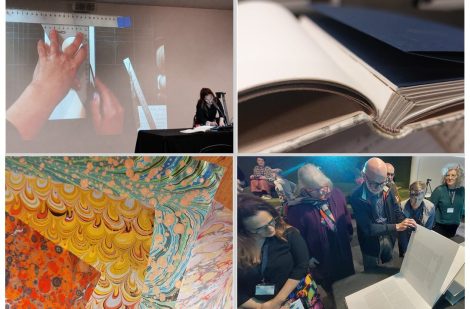
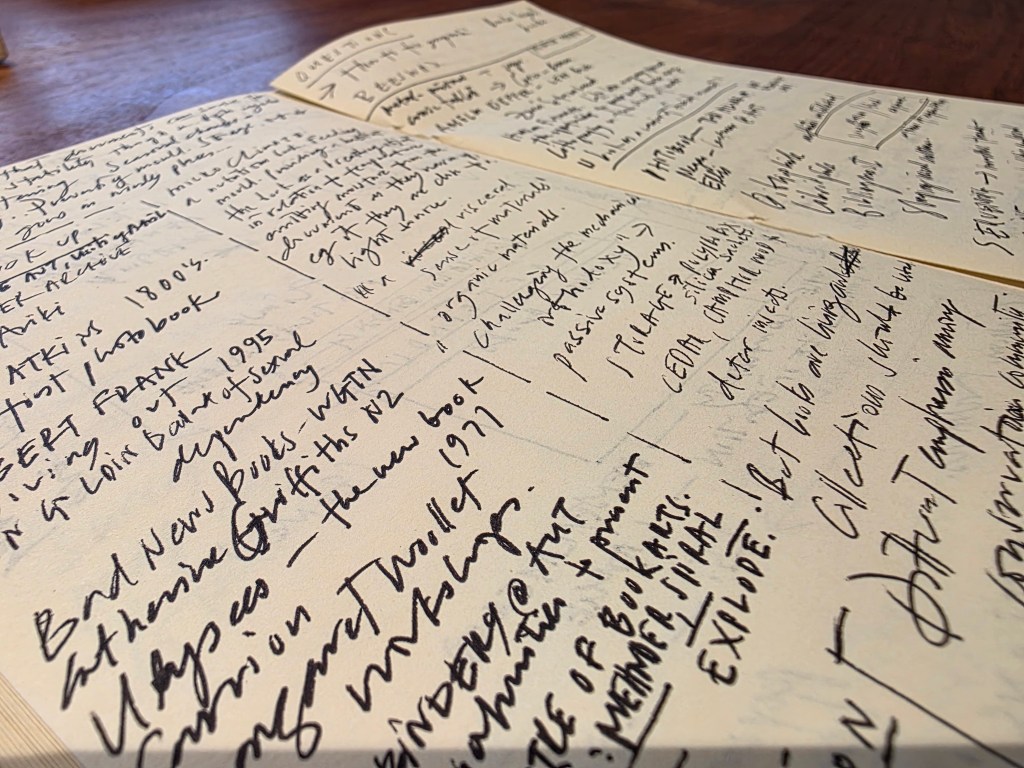
The world of books is vast – centuries of content, neatly packaged to share information, democratise learning and build knowledge. This post summarises a tiny part of last year’s NZ Association of Book Crafts Bind25 symposium centering on many things “book” (AUT, Tamaki Makaurau Sept 12 – 14, 2025). The event drew presenters from Aotearoa, the UK, USA, South America and Australia, covering a broad swathe of content. Despite making books for decades, this event, curiously, was the first time I’ve connected with a broader group of makers and explored the multiple contexts of handmade books in Aotearoa and beyond.
Bind25 was a feast: from sumptuous editions handstitched and presented to perfection (Louise James) to the intrigues of conserving and storing fragile papers (Chris Woods), to the business of the promoting and earning a sustainable living as a bespoke binder (Ben Elbel), books as unique sculptural objects (Monica Oppen), calligraphic lettering (Margaret Woollett), intriguing techniques for binding and creating lustrous surfaces (Sol Rebora, Coleen Curry), to building narrative content (Fiona Dempster). The unifying themes? The joy of making, and above all, valuing the handmade.
Materials
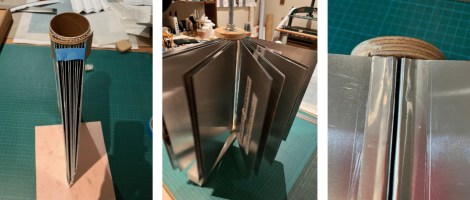
Monica Oppen described the challenges of using non-traditional materials – constructing a large (heavy!) book with binding and leaves made entirely from metal. While bindings, adornments and clasps have historically been made from metal – whole books are rare. However, some intriguing examples were shared: the metal book of the Italian Futurist Movement from the 1930s; Anselm Kieffer’s monumental library of c.200 lead books, The High Priestess / Zwei Stromland, and works by Beldan Sezen, I will kill you in dreams, 2023; and Don Glaister, Brooklyn Bridge: a love song, 2002.
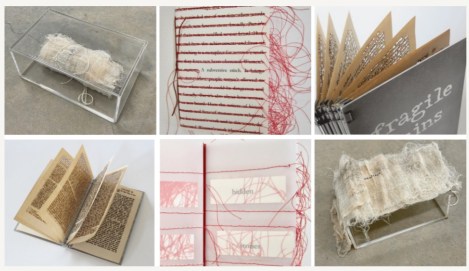
Using entirely different materials, Makayla Curtis described how she works with fabric pages (both to print on and to bind) and the impact fabric pages has on a reader/viewer. One aspect of using cotton, linen and silk for pages is transparency, which can simultaneously “…provide a glimpse of past and future“. As a printmaker, bookbinder and poet, she also works at the Museum of Transport and Technology as a voluntary letterpress compositor adding another dimension to book production and content.
Processes
Colleen Curry described how bookbinding leather is “...more than a cover, it’s a canvas for storytelling, a tactile and sensory experience”. Dyeing the leather and working the surface with layers of colour, applying foils, and marking the leather in many different ways, she creates visually rich unique works to complement the content of the inside pages.
Content
In her presentation, Meighan Ellis described the genre as photographs in a book format carefully arranged to tell a visual story, combining design and tactile experience. She shared insights as both a photobook collector and maker, exploring how they are created, the challenges of self-publishing, and her acclaimed project Temporal.
As a letter artist, Margaret Woollett uses paper, fabric, and thread to engage the senses and evoke emotion through tactile, layered storytelling. In her presentation, she shared her creative process, techniques, and lessons from years of practice, inviting participants to experience her work firsthand through examples and touchable samples.
Fiona Dempster referencing her own artist’s books described indirect narrative as storytelling through suggestion, relying e.g., on sensory experience. She discussed the importance of physical interaction with the pages: the speed, sonic and textural qualities of how the books are opened, handled, and navigated.
Conservation
In the first keynote, Conservator Chris Woods delivered a highly engaging account challenging long-held assumptions about the best conditions for storing and preserving fragile archives. He stressed that energy-intensive mechanical systems aren’t the answer, and passive approaches perform better, are cheaper to run and have less environmental impact. This approach means letting the building – airtight and well-insulated, and the boxed collections create a stable internal microclimate. He explained this works because books and archives hold far more moisture than the surrounding air, so the condition of the materials and the quality of the building matter more than tightly engineered airflow.
Business
In the second keynote, Ben Elbel described giving lovingly handmade books as gifts to family members… and received lukewarm responses in return. Cue nods and chuckles from the audience – myself included. The learning? Not everyone values the handmade let alone the nuances of bookbinding. Operating a specialist bookbindery in France, he underscored the importance of not being a generalist and narrowing the scope of your work to allow products and processes to be refined. The result is an optimised workspace, clearer communication with clients and a stronger understanding of their needs, along with consistent messaging to attract new clients. However, he also iterated the need to adapt and stick to the work that you want to do.
Until the next symposium: Bind27, Sydney!
 monicalogues